The Star Atlases Behind Cosmic Ascendant
Every picture in the app is a real engraving from a real celestial atlas, printed between 1603 and 1856. Here is where each one comes from, why it changes with the sky, and how six centuries of astronomers ended up illustrating a phone.
Everything you see was drawn by an astronomer
Open Cosmic Ascendant today and the picture behind the greeting is a lion — not a logo of a lion, not an illustration commissioned to look old, but Leo as Johann Elert Bode engraved him in Berlin in 1801, star for star, with the constellation's name lettered in his own hand.
Tomorrow it will still be the lion. On the 23rd of August it becomes Virgo, because that is when the sun crosses into her.
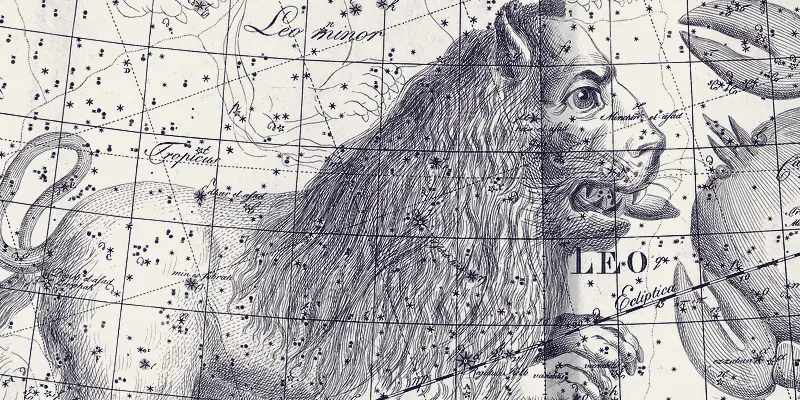
That is the whole idea. The imagery is not decoration applied to astrology; it is astronomy, and it changes because the sky changes.
Why old atlases
For about three hundred years, the people mapping the stars were also making some of the most beautiful printed objects in Europe. A star atlas had to do two jobs at once: record thousands of positions accurately enough to navigate by, and show a reader which shape those positions were supposed to make. The result is a strange and wonderful hybrid — a scientific instrument with a lion drawn over it.
Those books are now in the public domain, scanned at enormous resolution by libraries who did the hard part. What was missing was not the pictures. It was the decision about which picture belongs where.
The six atlases
**Johann Bode, Uranographia, 1801.** The largest star atlas ever published: twenty plates, more than 17,000 stars, every constellation anyone had ever proposed. Bode's zodiac carries the home screen — one plate for whichever sign the sun currently occupies, so the masthead turns over twelve times a year.
Bode named each sheet for its principal constellation and drew the neighbours alongside, which is why Leo shares a plate with Cancer, Virgo with Libra, and Scorpius with Sagittarius. Six of the twelve signs come from three sheets.
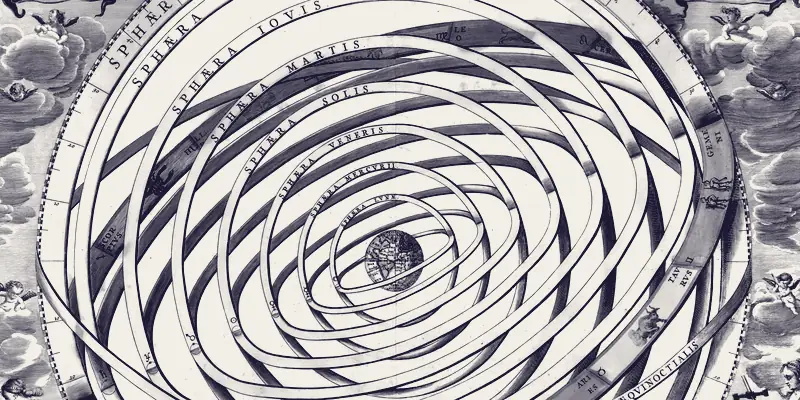
**Andreas Cellarius, Harmonia Macrocosmica, 1660.** The most ornamental of them, and the least like a modern chart: hand-coloured cosmological diagrams with cherubs in the corners. The natal chart page carries his Orbium Planetarum Terram Complectentium Scenographia — the planetary spheres drawn in perspective as nested bands, Saturn outermost, the Earth at the centre. A birth chart is an orbital diagram. This is the same idea, 350 years earlier.
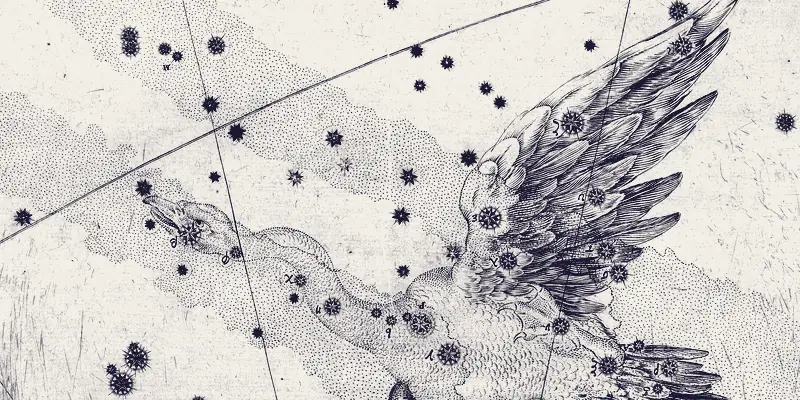
**Johann Bayer, Uranometria, 1603.** The oldest in the set, and the origin of the naming system astronomers still use — the brightest star in a constellation is its alpha. Bayer's Cygnus, wings open, sits behind the Big Three quiz. His Serpent lies behind the Oracle, which felt right: the serpent is the oracular animal, and Delphi's.
**Johannes Hevelius, Firmamentum Sobiescianum, 1690.** Famous for drawing the constellations mirror-reversed, as they would appear on a celestial globe seen from outside. His planisphere — an entire sky held in one circle — sits behind Birth Zenith, the feature about the sky over one particular place.
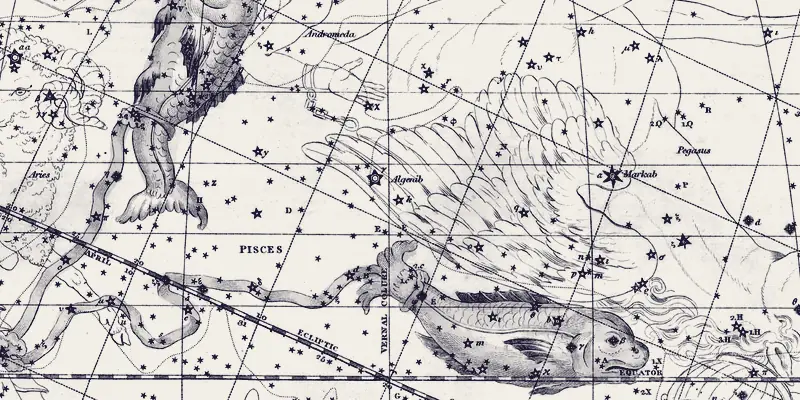
**Alexander Jamieson, Celestial Atlas, 1822.** Lighter and more open than Bode, with the constellations under English names: The Harp, Berenice's Hair, The Flying Horse. His northern hemisphere carries Circles — every figure in the sky inside a single circle, which is that page in a picture. His Pisces carries Pairs: two fish joined by a visible cord, which is exactly what a link between two people is.
His plate 29 has no figures at all — only labels and coordinates — and it sits behind the Chart Builder, the tool that makes a chart out of raw facts.
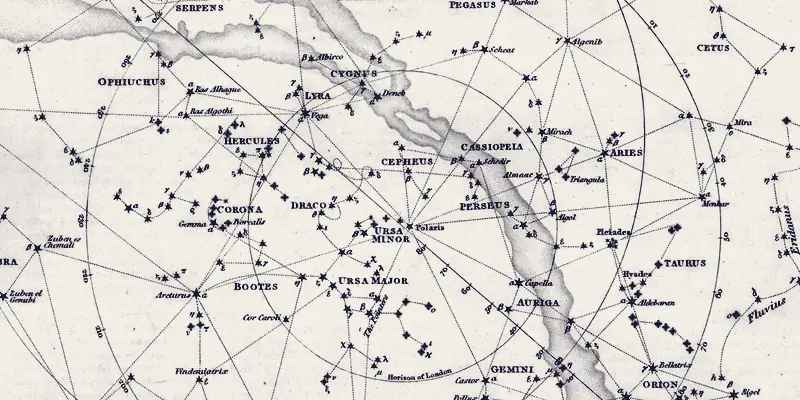
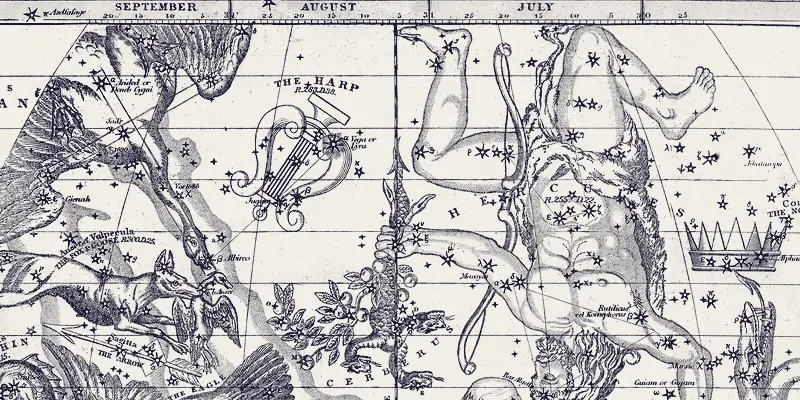
**Elijah Burritt, Geography of the Heavens, 1856.** An American schoolbook atlas, and the one with the neatest trick: Burritt printed the months along the border of each seasonal chart. The horoscope page carries the chart for the quarter you are in, so the picture says SEPTEMBER AUGUST JULY in its own lettering. Four plates, one per quarter, turning over with the year.
How they are treated
A scan dropped straight into a page reads as a borrowed picture. The recipe that makes them feel native is short:
Crop hard. Roughly a fifth of the original, centred on one figure. A full plate is a magnificent object and unusable at phone size, where dense line work turns to mud.
Flatten the paper. These are photographs of bound books, so each sheet carries a lighting gradient, and the plates with two constellations have a hard tonal step where the book's gutter falls. Leo's runs straight down the lion's face. Estimating the paper's brightness across the sheet and dividing it out removes the seam without touching the ink.
Reduce to two colours. Every plate is mapped to the palette of whichever theme you are using — ink on parchment, or, inverted, starlight on a night sky. This is what lets a hand-coloured 1660 diagram and a monochrome 1603 engraving sit in the same app without looking like a scrapbook.
The part that took longest
Twelve signs sounds like twelve files. It was not.
Wikimedia Commons has beautiful scans of most of Bode's zodiac, but for five signs — Capricorn, Aquarius, Pisces, Aries and Taurus — it has only thumbnails, 400 to 500 pixels wide. Enlarging one of those produces exactly the soft, mushy band that makes an old engraving look like a cheap reproduction, so the build refuses to do it.
The full Uranographia is scanned at 11,793 pixels in the Internet Archive. The missing five turned out to live on three of its plates, in the same pairs Bode had drawn them: Pisces with Aries, Capricornus with Aquarius, Taurus by itself.
The Burritt winter chart was harder still. Four of the five seasonal maps are on Commons; January to March is not, and the one scan that includes it is a two-page spread where that half is 768 pixels. The Library of Congress serves the same sheet through its image service at 8,295 pixels wide.
None of this is visible in the app, which is the point. It is simply that in late December the masthead becomes Capricorn, and the sea-goat is sharp.
Why bother
Because it is true, and because true things hold up.
An app about the sky can decorate itself with generic star fields and moon icons, and many do. What that communicates, quietly, is that the sky is a mood. Using the actual charts communicates the opposite: that people have been watching this carefully for four hundred years, writing down what they saw, and drawing it beautifully.
The plates are public domain because their authors are long dead and their work belongs to everyone now. Bode, Cellarius, Bayer, Hevelius, Jamieson and Burritt were not illustrating an app. But they were doing what we are trying to do — making the sky legible to somebody who is looking up and wondering — and their answer to that problem is still better than ours.
Full provenance for every plate, including source and licence, is kept in the project's plate library.